What Will You Learn in the SAP FICO Course?
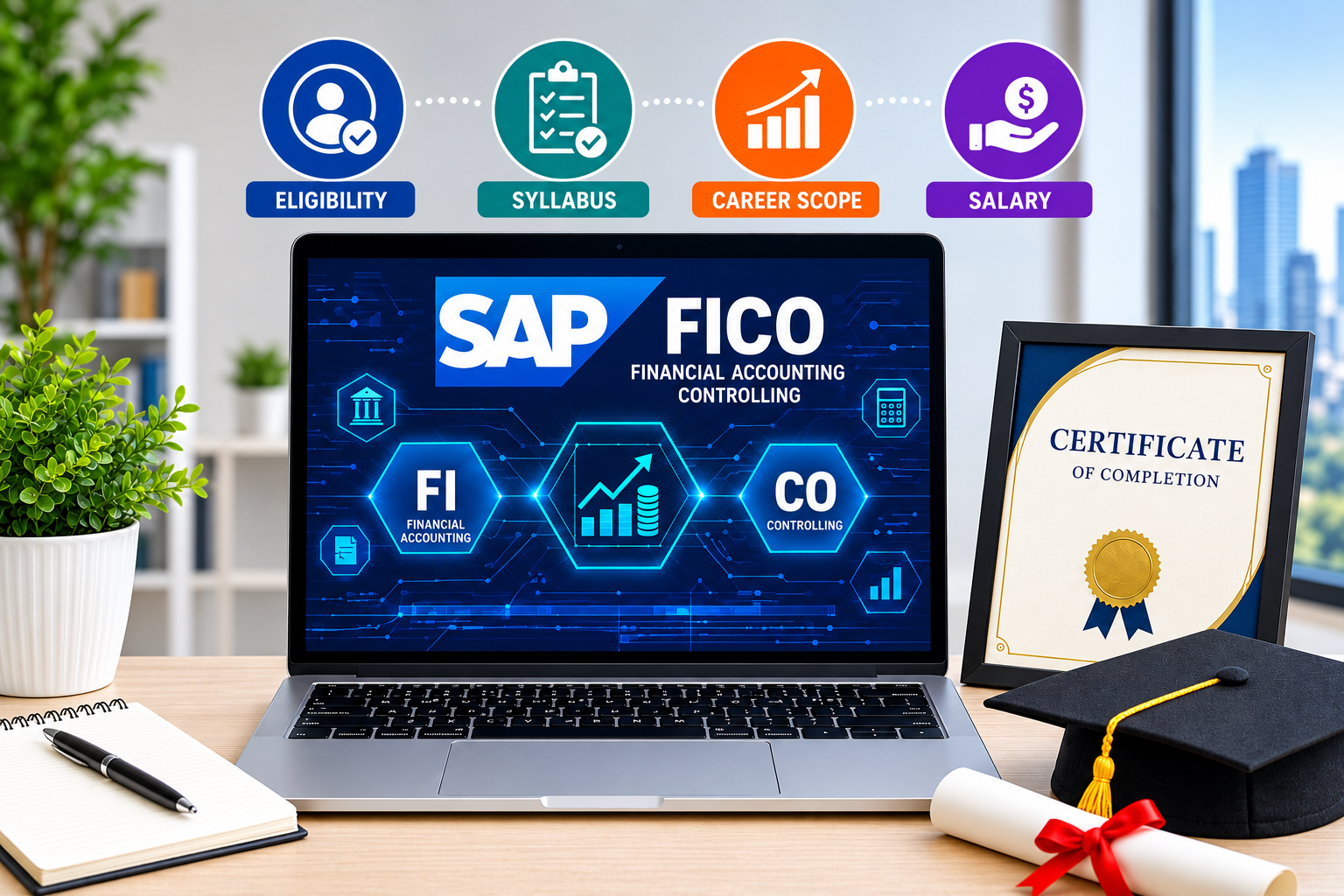
Primary Components of SAP FICO
1. SAP FI (Financial Accounting)Handles external financial statements, general ledger accounting, and legal reporting standards (such as IFRS and GAAP):
General Ledger (G/L) Accounting: Manages the complete chart of accounts, journal entries, and real-time ledger postings
Accounts Receivable (AR): Manages customer master data, invoicing, incoming payments, credit management, and dunning (payment reminders).
Accounts Payable (AP): Manages vendor master data, purchase invoices, outgoing payment runs, and vendor aging analysis.
Asset Accounting (AA): Tracks fixed asset lifecycles, including capitalization, depreciation runs, transfers, and asset retirements.
Bank Ledger & Cash Management: Handles electronic bank statement (EBS) reconciliation, petty cash, and short-term cash flow monitoring.
2. SAP CO (Controlling)Focuses on internal operational reporting, cost tracking, and profitability management:
Cost Element Accounting: Categorizes all primary and secondary costs incurred across the enterprise.
Cost Center Accounting (CCA): Tracks overhead costs associated with specific departments or cost centers (e.g., HR, IT, Production).
Internal Orders: Monitors short-term project expenses and tracks actual vs. budgeted spending for temporary tasks or events.
Profit Center Accounting (PCA): Analyzes revenues and expenses for independent profit centers/business units within the firm.
Product Costing (CO-PC) & Profitability Analysis (CO-PA): Calculates manufacturing product costs and evaluates profit margins across market segments, sales channels, and product lines.
Real-World Applications and Present-Day Industry Use
SAP FICO is deployed globally across banking, manufacturing, IT services, retail, and healthcare:
Automated Financial Statements: Instant generation of Balance Sheets, Profit & Loss (P&L) statements, and Trial Balances compliant with local tax laws.
Variance Analysis & Budgeting: Comparing planned budget figures against actual spend to highlight cost overruns.
Audit Trail & Governance: Maintaining complete transactional transparency with drill-down capabilities from balance sheet items down to individual line-item documents.
Streamlined Working Capital Management: Managing collections and vendor payment runs efficiently to optimize cash positions.
Future Scope of SAP FICO
As enterprises upgrade their core systems, the scope of SAP FICO revolves heavily around S/4HANA cloud architectures:
Migration to SAP S/4HANA Finance: Master the shift from legacy SAP ECC tables to the
Universal Journal (ACDOCA), eliminating data redundancy between FI and CO.
SAP Fiori UI Experience: Utilizing modern, role-based web and mobile applications for financial reporting and transaction approvals.
Automated & Continuous Financial Close: Real-time data processing that shortens month-end and year-end closing cycles from weeks to hours.
Predictive Accounting & AI: Using machine learning to forecast cash flow trends, detect fraud, and predict customer payment delays based on historical data.
Eligibility Criteria
Educational Background: Bachelor’s or Master’s degree in Commerce (B.Com / M.Com), Finance, Business Administration (MBA Finance), Accounting, or professional certifications (CA, CMA, CS). Engineering and CS graduates interested in financial ERP consulting are also eligible.
Work Experience (Optional): Prior domain experience in general accounting, audit, financial planning & analysis (FP&A), or IT consulting is highly beneficial.